

Medically Integrated Dispensing (MID) 101: Nuts and Bolts for Rheumatology Practices
Hey RPPA community!
Warning: You might want to grab a cup of coffee (or tea) ☕! This email is packed with information, so sip your favorite drink and settle in.
There has been a lot of Medically Integrated Dispensing (MID) discussion lately in our RPPA Facebook group, and not surprisingly, the MID session was also one of the most sought-after sessions at the 2025 RPPA Growth Summit.
This session didn’t just spark interest ✨ - it drove action.
Why? Because the panelists were candid. They shared real experiences and real numbers. More than one said it outright: “MID is a game changer”, mainly through clear bagging. In many ways, MID today feels like infusion did for rheumatology 25 years ago.
But MID isn’t just about profit - and that’s key. For most rheumatologists, it has to improve patient care too. And MID delivers on what matters most:
Patient access
Practice sustainability
Control over how care is delivered
That said, the information out there can feel overwhelming and MID is in my opinion much more complicated to implement than infusions in your office. There are often gaps in what’s presented, and the same questions keep coming up:
How do I actually implement MID?
Do I need help, or can I do this myself?
I’m a big believer in Who Not How (written by Dan Sullivan), which is all about shifting your mindset from how to do something to identifying who can help you do it well.
Of course, finding that “who” is a whole other conversation (and deserves its own post).
Before you even ask the question of “who,” having a solid foundation in MID is critical.
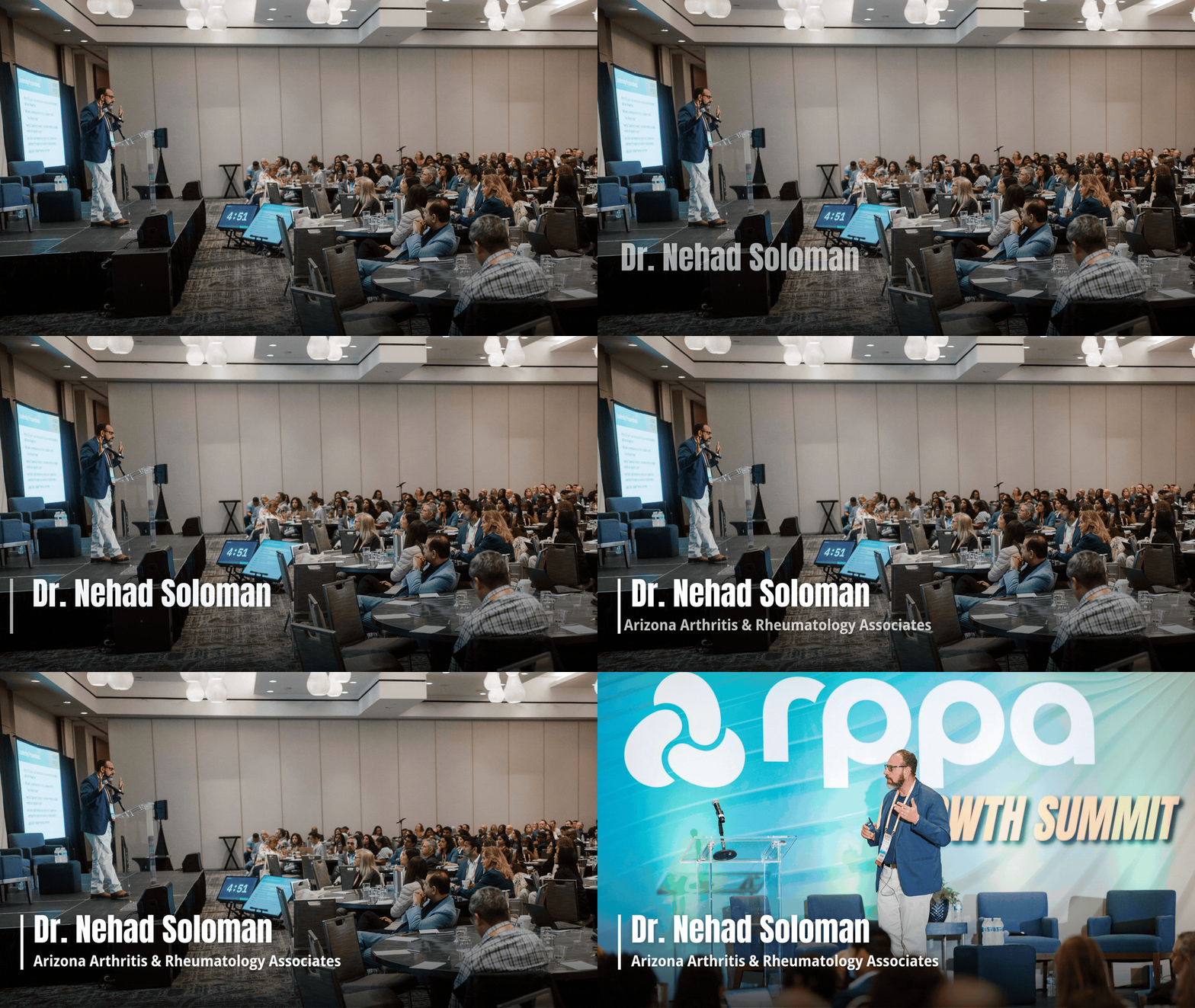
Below is a recap of our most popular session at the 2025 RPPA Growth Summit: Medically Integrated Dispensing (MID) 101: Nuts and Bolts for Rheumatology Practices, presented by Dr. Nehad Soloman - one of the early pioneers who tested the waters of MID and successfully made it work in private practice.
The Framework: the Nuts and Bolts of MID
Dr. Soloman walked through:
Legal and regulatory requirements
Credentialing and PBMs
Financial setup and wholesale pricing
Distribution and workflow
Staffing and team operations
Technology and pharmacy management systems
Clear bagging and why it changes the equation
He emphasized something that every practice owner needs to hear: Anything new takes time to become profitable.
If you remember what it took to build infusion services years ago, MID has a similar ramp. It requires planning, set-up time, and operational commitment. The first “big reality check” is your STATE matters.
Texas, New York, and New Jersey, in particular, have rules that differ significantly from many others. This matters because MID is not one national playbook. What is allowed, what is required, and what becomes a “non-starter” depends heavily on your state.
One of the fastest ways to get burned? Copying another practice’s MID model without understanding your own state’s rules.
MID is Not “infusion 2.0”
A key point he repeated in different ways. We are not retail pharmacists. We are not specialty pharmacists. This is not the same machine as your infusion center.
MID has its own regulatory framework, credentialing flow, and operational demands. If you go into it thinking “we’ll figure it out as we go,” you will feel the pain. If you go into it with structure and leadership, you give yourself a real chance of success!
Compliance: The Part You Cannot “wing”
He emphasized that MID brings real compliance responsibility, including:
State-specific licensing requirements
Patient consent requirements
“Any Willing Provider” rules (especially for Medicare and Medicare Advantage)
PBM audits
Surprise onsite inspections (space, refrigeration, storage, documentation)
Audits are about documentation and compliance. This is where having an experienced partner makes a big difference. Credentialing and PBMs: a grind, not a checkbox.
He described the PBM credentialing process as:
Lengthy applications (think 140 pages)
Fees ranging from $500 to $1,500
Little to no negotiation
Long timelines
He shared that with the right partner:
MID stand-up can often happen in 3 to 6 months
Without that experience:
It may take closer to 9 months
For a full in-house pharmacy:
Timelines can be longer depending on the state
Financial Setup: Where the Success Lives or Dies
This was one of the strongest takeaways. He warned that if you cannot secure acceptable wholesale terms, you can end up underwater, especially on self-injectables.
He referenced wholesaler discounts often landing in the range of:
2.5 to 5 percent off WAC
That discount is not a “nice to have.” It can be the difference between MID being viable or being a slow drain on your practice.
He also emphasized practical setup steps, like:
Separate pharmacy bank account
Board registration and fees
Supplies and patient materials
Operational readiness before launch
Staffing and Workflow
MID creates a surprising amount of workflow volume. He mentioned that depending on how robust your program is, there can be:
Large number of inbound and outbound touches
Complex coordination around prior auth, pickup vs courier, documentation, and follow-through
This is why the “we’ll just add this to our current team” plan usually breaks. If your staff is already operating at capacity, MID will expose that quickly.
Technology: Not Optional
A good pharmacy management system matters because it supports:
Real-time analytics
Financial projections
Out-of-pocket estimation for patients
Workflow coordination
Audit readiness
He also made the point that data issues exist in nearly every system, but operating blind is worse than operating with visibility.
Clear bagging: Why this Changes the Game
He explained clear bagging as “white bagging under your own control.” It can help practices:
Preserve margin on certain infused meds
Improve access for Medicare and Medicare Advantage patients
Separate authorization correctly (pharmacy benefit vs medical benefit)
Store meds properly with separate refrigeration and workflows
He tied this to the 2025 cap and smoothing changes, and also discussed the role of foundation grant assistance for eligible patients.
The deeper point here was important. It can also be about lowering patient financial burden when done upfront and done correctly.
The Two Audience Questions that Hit Home
1) ACO / CIN alignment
A thoughtful question was raised about whether ACOs or CINs could affect a practice’s appetite for MID.
Dr. Solomon’s response was essentially: It depends on your contract structure.
Their practice is loosely connected with ACOs that do not get involved in their business, but if you are heavily aligned with incentives, that can influence strategy.
2) Can multiple small practices band together?
He said there may be a way, but it gets complex fast. It likely requires:
A full pharmacy model (not MID)
An MSO structure
Profit distribution based on ownership shares, not prescribing volume
If you’re considering medically integrated dispensing, your best next step is doing smart homework. Reach out to as many rheumatologists as you can about their MID experience, especially those in your state.
Share what you’re learning with others. Collectively, as a community, this is how we shine a light on which partners are worth talking to… and which ones to steer clear of.
RPPA PARTNERS
Ask Velma is a physician-found and physician-led company. Their medical virtual assistants take care of scheduling, billing, and everyday operations so your team can stay focused on patients.
They sign BAA and are in full HIPAA compliance. Learn more at Ask Velma and see how they can support your practice.
We use affiliate links for our favorite vendors. If you click and sign-up with the link, RPPA may receive a small commission at no extra cost to you.
HOT TOPICS IN THE RPPA FACEBOOK GROUP
Get your cup of coffee ready and enjoy the hottest discussions (both CLINICAL as well as PRACTICE RELATED) inside our RPPA Facebook Group.
** Facebook Group open to rheumatologists and fellows **
(be sure to include your NPI # in your request to join our group).
🎯 CMS Updates Medicare “Direct Supervision” Rules (Effective Jan 1, 2026)
👉👉 <<LINK>> I shared that CMS is permanently allowing “direct supervision” to be provided via real-time audio + visual telecommunications (not audio-only), meaning the supervising clinician must be immediately available but does not need to be onsite. Read the full Facebook post for the key details and discussion.
🎯 Medically Integrated Dispensing: Early Wins + Real Talk from Dr. Samy Metyas
👉👉 <<LINK>> Dr. Metyas shared a practical update after starting MID and sending his first prescriptions, including why he believes every rheumatology practice should pursue in-office dispensing, why starting sooner matters due to certification timelines, and why having a dedicated third-party partner is key for profitability and operations. Read the full Facebook post for the full breakdown and takeaways.
🎯 Recurrent Pseudogout Knee Effusions Despite Treatment
👉👉 <<LINK>> A member is looking for advice on a patient with recurrent left knee pseudogout effusions and moderate to severe OA, with limited response to colchicine, low-dose prednisone, steroid injections, and Synvisc. Comment on the post to share what’s worked in similar cases.
🎯 Tinted Window DMV Exemptions for Lupus Patients
👉👉 <<LINK>> A member is asking whether they provide DMV medical exemptions for tinted windows for lupus patients and if there’s a meaningful clinical benefit. Read the full Facebook post and comment to share your approach.
🎯 Internal Medicine Recertification Resources
👉👉 <<LINK>> A member is recertifying for Internal Medicine and wants recommendations for helpful prep resources. Comment on the post to share what you used.
🎯 Ruxience Price Increase and Reimbursement Cut
👉👉 <<LINK>> A member is asking if Ruxience increased by nearly $800 while reimbursement was cut roughly in half. Read the full Facebook post and comment if you’re seeing the same change (and how you’re handling it).
🎯 Misattributed Negative Google Review on Maps
👉👉 <<LINK>> A member found a negative Google review incorrectly attached to one of their doctors on Google Maps. Comment on the post if you’ve been able to fix or remove reviews like this.
🎯 VA Hiring Opportunity: Experienced AskVelma VAs Available
👉👉 <<LINK>> I shared that AskVelma has several experienced VAs available (14 to 20 months in a rheum clinic) who are already trained in auths, billing, insurance, phones, and scheduling, and I can connect interested practices directly with their team. Read the full Facebook post for details and next steps.
🎯 Practice Marketing Pearl
👉👉 <<LINK>> A member shared a simple approach to get more meaningful Google reviews: ask “surprise and delight” patients to write to the version of themselves before they started care. Read the full Facebook post and share your own marketing pearls.